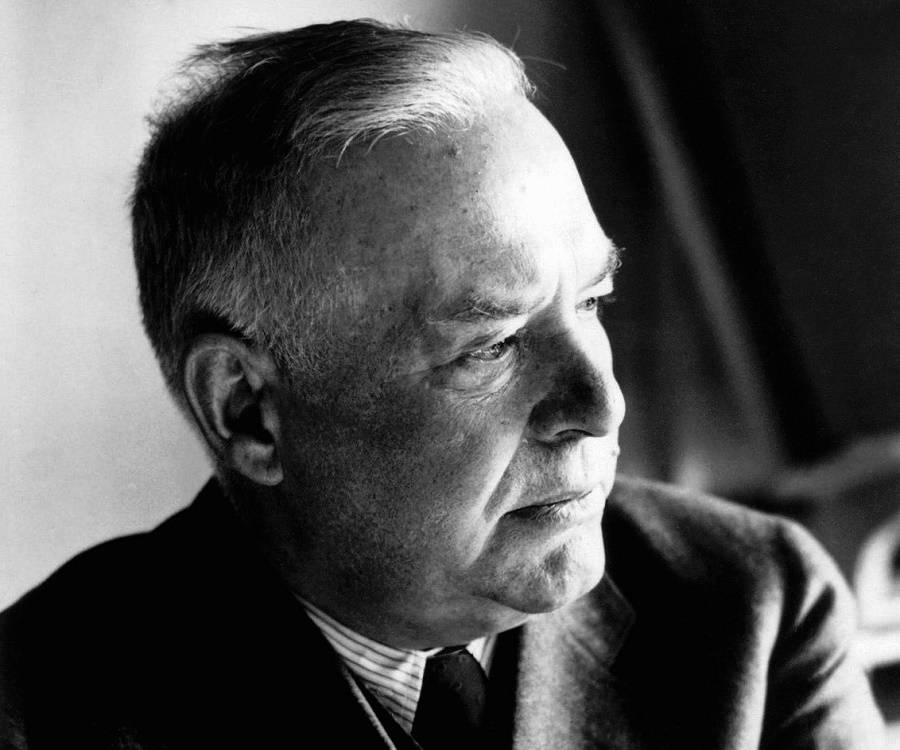
Wallace Stevens
ROBERT SIEGEL, host: Now in praise of Wallace Stevens. The American poet passed away 50 years ago this year. Commentator and linguist Jay Keyser saves his highest praise for one of Stevens' poems.
JAY KEYSER: With something as personal as a poem, it's risky making hard and fast judgments. That won't stop me. I declare that Wallace Stevens wrote the best short poem in the English language, bar none, and in a minute I'll tell you why. But first, listen to the poem.
It's called 'The Snow Man.' (Reading) `One must have a mind of winter to regard the frost and the boughs of the pine trees crusted with snow, and have been cold a long time to behold the juniper shagged with ice, the spruces rough in the distant glitter of the January sun, and not to think of any misery in the sound of the wind, in the sound of a few leaves, which is the sound of the land full of the same wind that is blowing in the same bare place for the listener, who listens in the snow and, nothing himself, beholds nothing that is not there, and the nothing that is.' Why is this poem so good? Unlike any other English poem I've read, 'The Snow Man' marries what it's about with the way it's built. If you were to parse it the way I was taught in high school, diagraming all those clauses and phrases on those slanted lines, you would come up with a perfectly balanced mobile built around the conjunction `and.' That's the trick of the poem.
Each clause seems to be coming to an end and then suddenly up pops another `and.' It begins `One must have a mind of winter to regard the frost and the boughs of the pine trees crusted with snow.' Fine, that looks like the end of the first sentence.
But, no, it goes on impelled by `and.' `One must have a mind of winter to regard the frost and the boughs of the pine trees crusted with snow and have been cold a long time to behold the juniper shagged with ice, the spruces rough in the distant glitter of the January sun.' There, we're finished with the `ands.' The very next word in the poem is another pesky `and.' Stevens is forcing his readers to reanalyze what they have just read again and again and again. I once put all the words of the poem on little white cards and made a mobile out of it. It dangled, perfectly balanced, like an Alexander Calder creation.
The poem, twisting and turning when I blew on it, became the visual counterpart of what it's about. But what is it about? The poem is a recipe for seeing things as they really are. To do that, you must see the world the way the snow man does. The snow man is free of human biases. He knows that in winter the days aren't cold and miserable; you are.
To see like him, you must constantly challenge your own assumptions. It's one thing to say that in words. It's quite another to say it in the structure the words hang on. No one did it before. No one has done it since. You can measure great jugglers by how many balls they keep in the air. It's the same thing with poets.
MELISSA BLOCK (Host): You're listening to ALL THINGS CONSIDERED from NPR News. Copyright © 2005 NPR. All rights reserved. Visit our website and pages at for further information. NPR transcripts are created on a rush deadline by, an NPR contractor, and produced using a proprietary transcription process developed with NPR.
This text may not be in its final form and may be updated or revised in the future. Accuracy and availability may vary. The authoritative record of NPR’s programming is the audio record.
Wallace Stevens Born ( 1879-10-02)October 2, 1879, U.S. Died August 2, 1955 ( 1955-08-02) (aged 75), U.S. Occupation Poet, insurance executive Nationality American Period 1914–1955 Literary movement Notable works ' ' ' Notable awards (1951) Spouse Elsie Viola Kachel (m. 1909–1955) Children Holly Stevens (1924–1992) Signature Wallace Stevens (October 2, 1879 – August 2, 1955) was an American poet. He was born in, educated at and then, and he spent most of his life working as an executive for an insurance company in. He won the for his Collected Poems in 1955. Some of his best-known poems include ', ', ', ', ', ', and '.
Contents. Life and career Education and marriage The son of a prosperous lawyer, Stevens attended as a non-degree special student, after which he moved to and briefly worked as a. He then attended, graduating in 1903. On a trip back to Reading in 1904 Stevens met Elsie Viola Kachel (1886–1963, also known as Elsie Moll), a young woman who had worked as a saleswoman, milliner, and stenographer. After a long courtship, he married her in 1909 over the objections of his parents, who considered her lower-class.
As The New York Times reported in an article in 2009, 'Nobody from his family attended the wedding, and Stevens never again visited or spoke to his parents during his father’s lifetime.' A daughter, Holly, was born in 1924. She later edited her father's letters and a collection of his poems. In 1913, the Stevenses rented a New York City apartment from, who made a bust of Elsie. Her striking profile was later used on Weinman's 1916–1945 design and possibly for the head of the. In later years Elsie Stevens began to exhibit symptoms of mental illness and the marriage suffered as a result, but the Stevenses remained married. Career After working for several New York law firms from 1904 to 1907, he was hired on January 13, 1908, as a for the American Bonding Company.
By 1914 he had become the vice-president of the New York office of the Equitable Surety Company of. Poetry. (1923). Ideas of Order (1936). Owl's Clover (1936).
The Man with the Blue Guitar (1937). Parts of a World (1942).
Transport to Summer (1947). The Auroras of Autumn (1950). The Collected Poems of Wallace Stevens, New York: Vintage Books, 1954. Posthumous collections. Opus Posthumous (1957). The Palm at the End of the Mind (1972). Collected Poetry and Prose (New York:, 1997).
Selected Poems (John N. Serio, ed.) (New York:, 2009) Prose.
The Necessary Angel (1951) Posthumous publications. Letters of Wallace James Stevens, edited by Holly Stevens (1966). Secretaries of the Moon: The Letters of Wallace Stevens & Jose Rodriguez Feo, edited by Beverly Coyle and Alan Filreis (1986). Sur plusieurs beaux sujects: Wallace Stevens's Commonplace Book, edited by Milton J. Bates (1989). The Contemplated Spouse: The Letters of Wallace Stevens to Elsie Kachel, edited by D.J. Blount (2006) Plays.
Three Travelers Watch a Sunrise (1916) References. Baird, James. The Dome and the Rock: Structure in the Poetry of Wallace Stevens (1968).
Wallace Stevens Blackbird
Bates, Milton J. Wallace Stevens: A Mythology of Self (1985). Beckett, Lucy. Wallace Stevens (1974).
Wallace Stevens Quotes
Beehler, Michael. Eliot, Wallace Stevens, and the Discourses of Difference (1987). Benamou, Michel. Wallace Stevens and the Symbolist Imagination (1972). Berger, Charles.
Forms of Farewell: The Late Poetry of Wallace Stevens (1985). Bevis, William W. Mind of Winter: Wallace Stevens, Meditation, and Literature (1988). Blessing, Richard Allen. Wallace Stevens' 'Whole Harmonium' (1970). Wallace Stevens: The Poems of Our Climate (1980).
Bloom, Harold. Figures of Capable Imagination (1976). Borroff, Marie, ed. Wallace Stevens: A Collection of Critical Essays (1963).
Brazeau, Peter. Parts of a World: Wallace Stevens Remembered (1983). Brogan, Jacqueline V. The Violence Within/The Violence Without: Wallace Stevens and the Emergence of a Revolutionary Poetics (2003).
Things Merely Are: Philosophy in the Poetry of Wallace Stevens (2005). Wallace Stevens' Supreme Fiction: A New Romanticism (1987).
Stevens' Poetry of Thought (1966). Doggett, Frank. Wallace Stevens: The Making of the Poem (1980). Doggett, Frank (Ed.), Buttel, Robert (Ed.). Wallace Stevens: A Celebration (1980). Wallace Stevens (1960).
Galgano, Andrea. L'armonia segreta di Wallace Stevens, in Mosaico (2013).
Grey, Thomas. The Wallace Stevens Case: Law and the Practice of Poetry (1991). Ehrenpreis, Irvin (Ed.). Wallace Stevens: A Critical Anthology (1973). Enck, John J. Wallace Stevens: Images and Judgments (1964). Filreis, Alan.
Modernism from Right to Left: Wallace Stevens, the Thirties & Literary Radicalism (1994). Hines, Thomas J. The Later Poetry of Wallace Stevens: Phenomenological Parallels With Husserl and Heidegger (1976). Hockney, David.
The Blue Guitar (1977). Kessler, Edward, 'Images of Wallace Stevens' (1972). Leggett, B.J. Early Stevens: The Intertext (1992). Leonard, J.S.
& Wharton, C.E. The Fluent Mundo: Wallace Stevens and the Structure of Reality (1988). Litz, A. 'Introspective Voyager: The Poetic Development of Wallace Stevens' (1972). Longenbach, James. Wallace Stevens: The Plain Sense of Things (1991). MacLeod, Glen.
'Wallace Stevens and Modern Art: From the Armory Show to Abstract Expressionism' (1993). McCann, Janet. Wallace Stevens Revisited: The Celestial Possible (1996). Ragg, Edward. 'Wallace Stevens and the Aesthetics of Abstraction' (2010). Tanaka, Hiroshi.
'A New Attempt of an American Poet: Wallace Stevens.' In Papers on British and American Literature and Culture: From Perspectives of Transpacific American Studies. Tatsushi Narita.
Nagoya: Kougaku Shuppan, 2007. On Extended Wings: Wallace Stevens' Longer Poems (1969). Vendler, Helen.
Wallace Stevens: Words Chosen out of Desire (1986). Woodman, Leonora. Stanza My Stone: Wallace Stevens and the Hermetic Tradition (1983) External links Wikiquote has quotations related to: has original works written by or about:. at. at PoetryFoundation.org.
audio, video and full transcripts from. at the. at. at (public domain audiobooks). Wallace Stevens Audio Project from the. at the Online Archive of California.